Last updated 2026-09-02
How to prove an AI project actually worked
The short answer
Most AI projects cannot prove they worked, because nobody wrote down what success would look like before the work started, so there is nothing to measure the result against. Proving AI ROI is a discipline, not a bigger dashboard: state the expected result in advance, in numbers the business already trusts, lock that expectation before anyone knows the outcome, measure the same figure afterward, and keep the comparison as your evidence. It is the same discipline Almanexa locks in by default, on every decision it records.
Why the question is so hard to answer
Ask a team to prove an AI project worked, and most reach for whatever number is easiest to pull afterward: logins, tickets touched, a demo that looked convincing. That is a timing problem more than a technology one: AI project success criteria were never fixed before the work began, so there is nothing solid to hold the actual result against, only a feeling about how it went. Industry analysis puts roughly 80% of the distance between a working prototype and something that shows up in the numbers down to data, governance, workflow integration and measurement, not the underlying model. The measurement half of that work is exactly the part most projects skip.
The method: state it, lock it, measure it, keep it
Proof follows a fixed order, and it holds however the business measures itself.
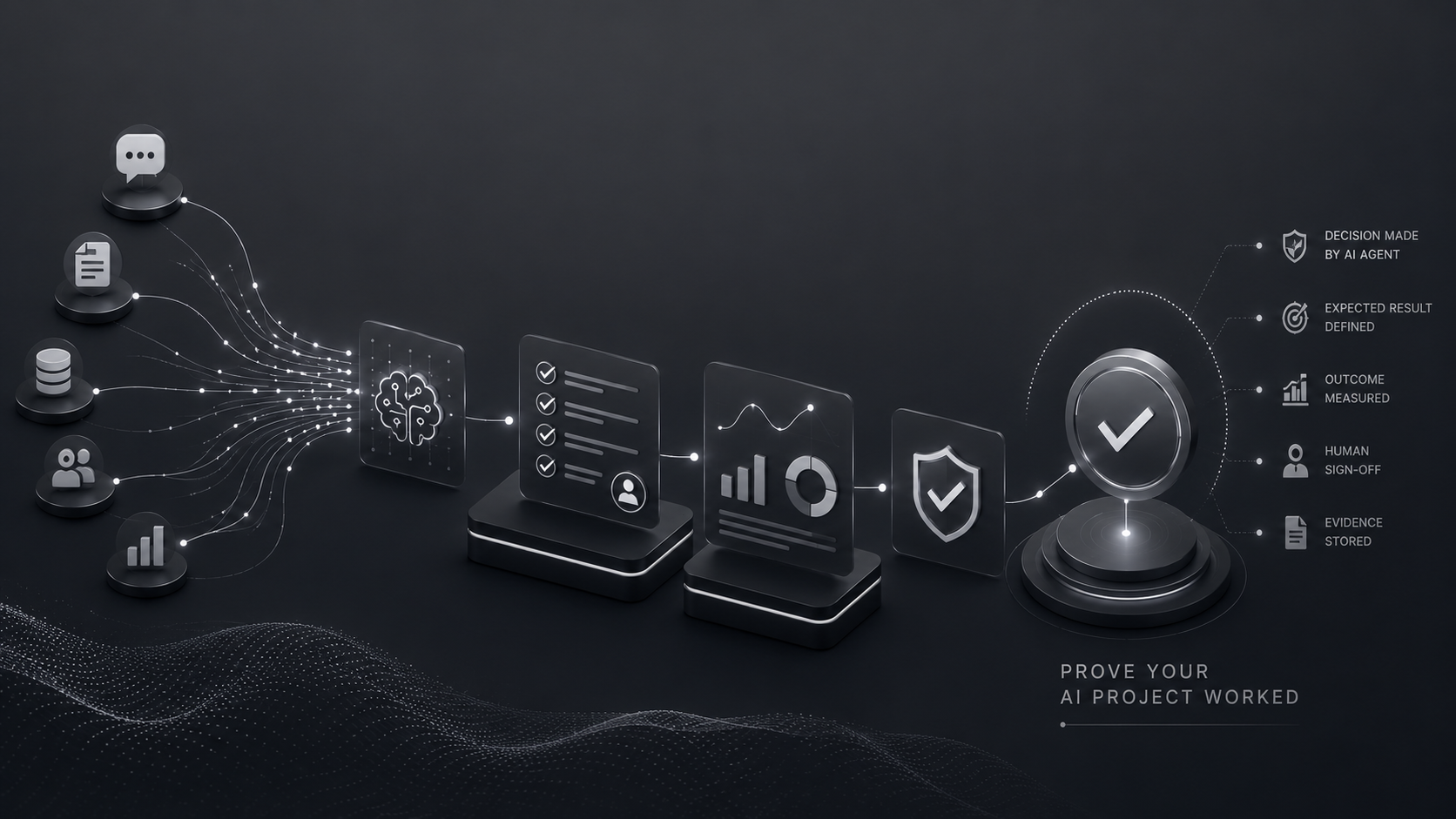
- Before the work starts, write the expected result in numbers the business already tracks: cycle time, cost per case, error rate, resolution time, or a plain yes or no outcome.
- Lock that expectation so it cannot be revised once results start arriving. An expectation still open to editing after the fact is not a criterion, it is a story.
- When the work is done, measure the exact same figure, the same way, over a comparable period.
- Keep the pairing, expectation next to outcome, as the record. That pairing is what evidence means here: not an activity count, but a stated expectation and a measured result sitting side by side.
Whether that order runs in a spreadsheet or inside a system built for it, the rule that keeps it honest is the same: an expectation recorded after the outcome is known does not count. Almanexa enforces exactly that rule on every decision it records, so the comparison can never be quietly rewritten once the answer is known.
Measurable outcomes, not activity dashboards
Dashboards are good at reporting activity: tokens spent, tickets touched, adoption rate, logins. None of that says whether the outcome the project was meant to produce actually arrived. An assistant can show strong adoption and change nothing that a finance team would recognize. Usage is a leading indicator at best, evidence that people opened the tool, not proof that the business result showed up, which is why a team that wants to measure AI impact honestly looks past adoption entirely. A program lead who can only report activity has, in practical terms, nothing to show a skeptical budget owner.
Build the business case on numbers you already trust
The strongest AI business case reuses the metrics finance and operations already track, rather than inventing a new AI-specific score nobody else recognizes. If the number was already how the business judged success before an AI project touched the process, an improvement against it needs no translation and invites no argument about whether the measurement itself was fair. The argument left over is the only one worth having: did the number move, and by how much.
What this proves, and what it does not
Done honestly, this method proves one thing clearly: whether the expected result showed up, on the metric the business chose in advance, within the period it was expected to show up in. It does not prove that one AI project changed the company's overall profit. Too much else moves in a business during the same period for that claim to rest on one comparison, and treating a met expectation as proof of company-wide impact overstates what was measured. Keeping the two claims separate, an expectation that was met, and a profit figure that was influenced, is what keeps the evidence honest enough to survive a second look.
The same expectation-then-outcome pattern extends past a single project into something an organization keeps: see what decision memory is, or read why most AI pilots never show a return for the failure pattern this method is built to avoid.
Questions we hear
- What should we measure for an AI project?
- Measure the number the business already trusts for that process: cycle time, cost per case, error rate, resolution time, or a plain yes or no outcome. Choose it before the work starts, and hold it fixed.
- Is this the same as an AI dashboard?
- No. A dashboard reports activity: usage, tokens, tickets touched. Proof means writing the expected result down first, locking it, then measuring the same thing afterward and keeping the comparison.
- What if the result is worse than we expected?
- A recorded miss, with the real result attached, is the most useful thing you own. It tells you exactly where the expectation was wrong, which is worth more than a result nobody wrote an expectation down for.