Last updated 2026-08-07
Why lessons learned programmes fail, and what replaces them
The short answer
Almost every organization has run a lessons learned programme: a retrospective, a post-project review, a knowledge base for the things it wished it had known sooner. Almost none of them can point to a specific decision the programme changed. The usual explanation is that people did not write things down. The more accurate one is that they did, and almost nothing happened to what they wrote. Capture was never the failing part. Application is.
The retrospective that nobody reads
A project closes, and a retrospective gets written: what went well, what did not, what the team would do differently next time. It gets filed, sometimes presented once to a room already thinking about the next project, and then it joins the last one and the one before that. Nobody opens it again until, eighteen months later, a near-identical project starts, and nobody thinks to look. The retrospective was not wrong. It was simply never in front of anyone at the moment a similar decision was actually being made again.
The write-only archive
Knowledge management systems accumulate the same way: a searchable library that grows every quarter and gets consulted less each year, because searching it requires already suspecting the answer is in there, and knowing what to call it. The research on this failure is blunt about where it sits. Organizations are consistently good at capture and consistently poor at application: the documents exist, the tagging is reasonable, and the lessons inside them still get repeated as fresh mistakes, because writing something down and a person encountering it at the right moment are two different problems, and most programmes only solve the first.
An unpaid chore with no payback for the person doing it
Ask someone to write the retrospective and you are asking them for a report that helps a future colleague they will likely never meet, on a project they have already moved on from, for no benefit to their own week. It competes with everything that has a deadline attached to it, and it reliably loses. A programme that depends on that kind of goodwill degrades on a predictable schedule: thorough in year one, a template half filled in by year three, a line that reads see previous report by year five.
Execution rewarded, learning quietly punished
There is a sharper reason the misses go missing. Most organizations reward the person who delivered on time and say little about the one who documented an honest failure, so the rational move is to write the retrospective that protects a reputation, not the one that is most useful to the next team. A lessons learned archive built this way is quietly filtered before anyone reads it: the wins are recorded generously, the misses are softened or left out, and the archive ends up teaching confidence rather than caution. The Project Management Institute puts a number on the cost of this: organizations lose an estimated 2.4 million pounds a year to poor knowledge management practices, and 83 percent report they lack real maturity in turning captured knowledge into realized benefit.
What replaces it
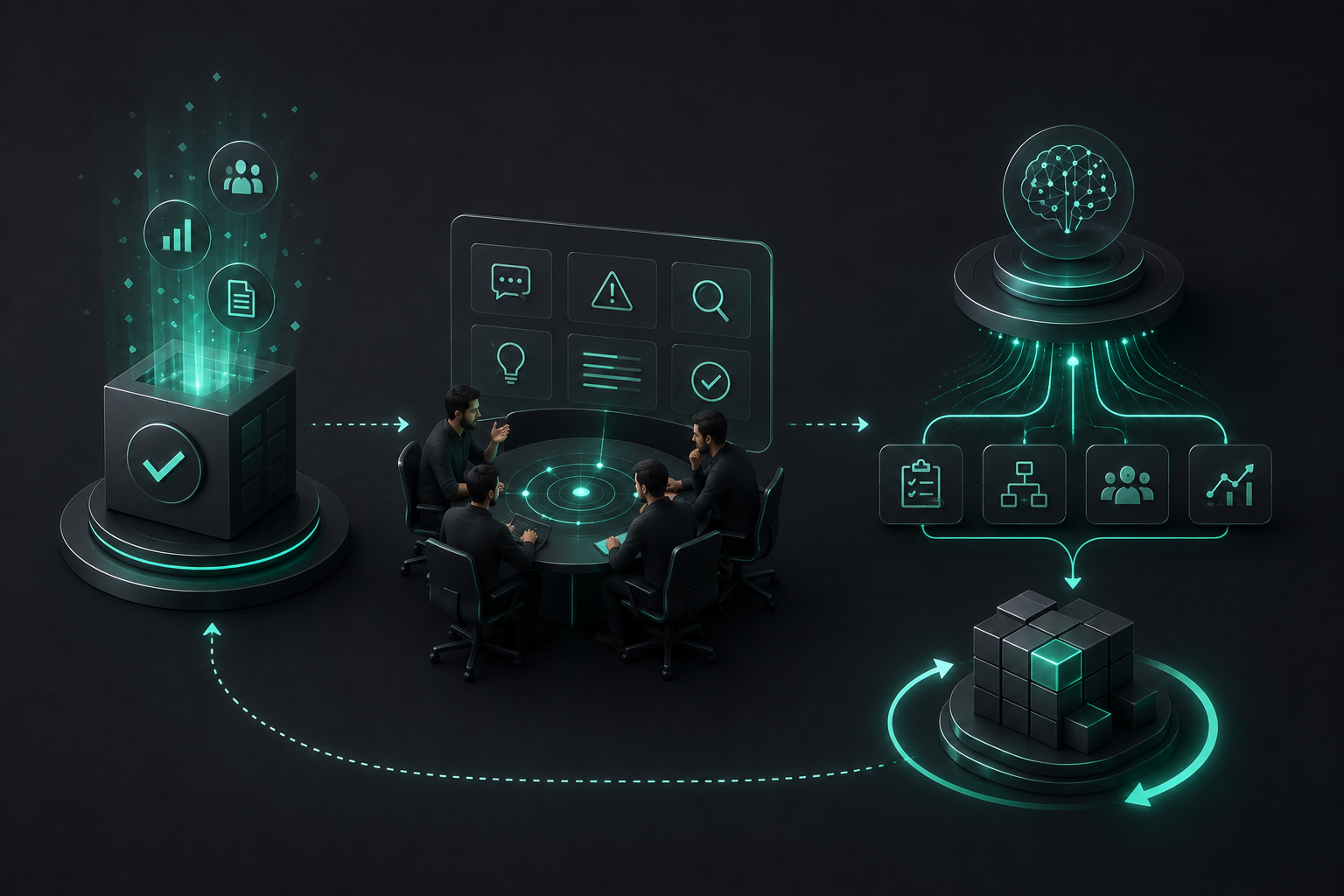
The fix is not a better template or a stricter mandate to write things down. It is attaching the lesson to the decision it affects, and delivering it at the moment the same choice comes round again, rather than filing it under a project name nobody will search for. Almanexa records the expectation and the outcome together, grades the pairing, and only serves a lesson once a second, different person has reviewed and approved it, with their name attached and the source shown. Nothing gets buried, because nobody is rewarded for burying it: the record shows misses next to wins, on equal footing, because both were graded the same way.
Read about how the record gets built without new habits, or see what decision memory is.
Questions we hear
- Why do lessons learned databases go stale?
- Because writing the entry is unpaid work with no benefit to the person doing it, and the finished archive only helps someone who already knows to search for it. Without a payback loop, a thorough entry in year one becomes a line reading see previous report by year five.
- Is this a wiki or a knowledge base?
- No. A wiki waits to be searched, and searching it requires already suspecting the answer is there. Almanexa attaches a lesson to the decision it affects and delivers it when the same choice comes round again, so nobody has to go looking for it first.
- What happens to lessons that stop being true?
- A lesson is not permanent by default. A named reviewer can mark one deprecated the same way one gets approved, and a deprecated lesson stops being served immediately. The record keeps it on file rather than deleting it, so the history stays honest.