Last updated 2026-08-29
Human in the loop does not scale. Proving oversight does.
The short answer
A reviewer facing hundreds of queued approvals a day is not exercising oversight, they are rubber-stamping, and the coverage numbers now say so openly: Gartner expects 40% of enterprise applications to embed task-specific AI agents by the end of 2026, up from under 5% in 2025, while 58% of executives in a 2026 survey reported an AI-related security incident or near miss in the past year. Removing the human is unjustifiable. Keeping one on every decision no longer scales. What scales is oversight concentrated where the evidence says it is still needed, backed by a record of where the machine has been right, for how long, and who allowed it to act. Almanexa keeps that record.
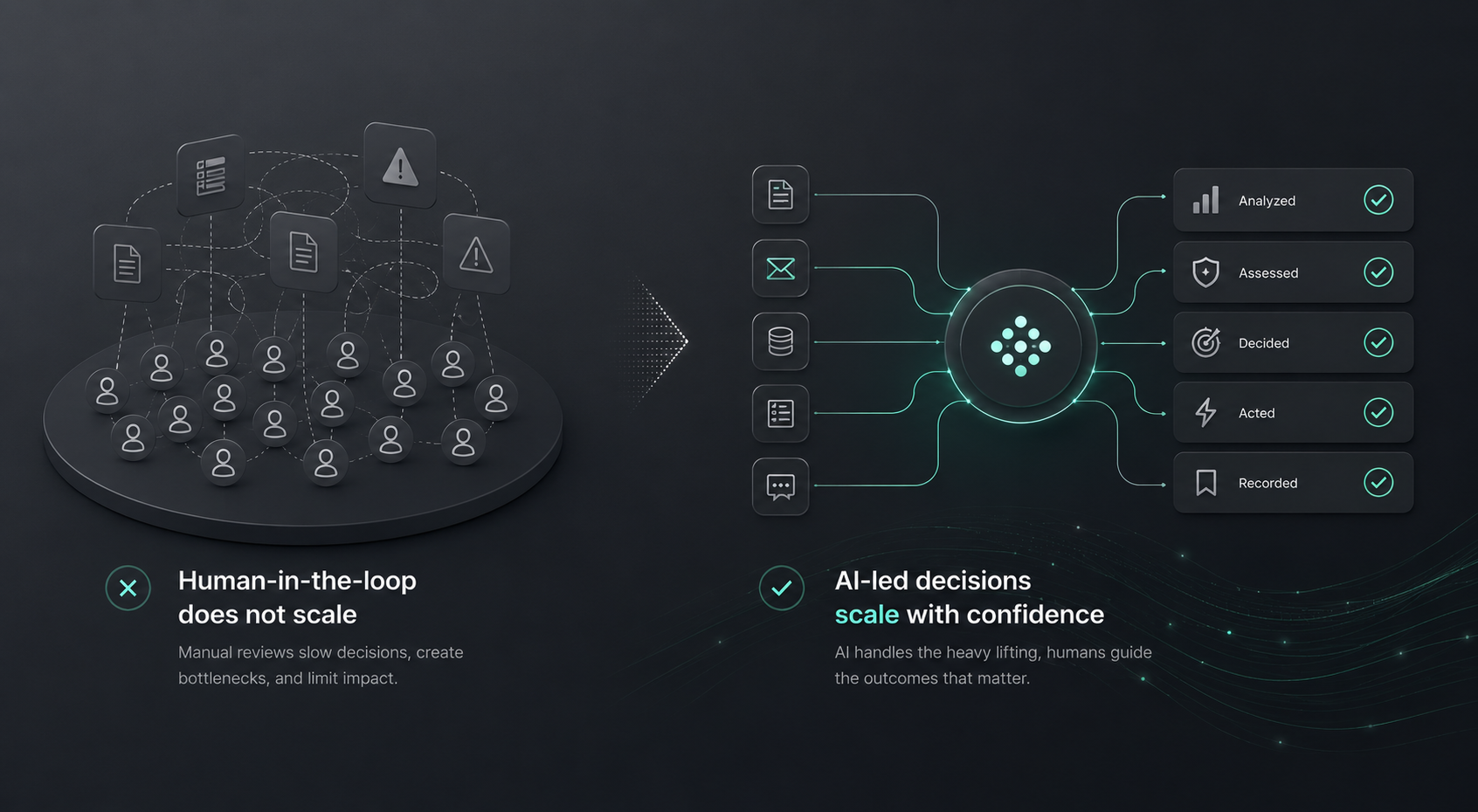
The reviewer became a rubber stamp
Put a person in front of hundreds of queued decisions a day, and approval fatigue is the predictable result: approvals move fast, objections do not, and review becomes a formality that mainly exists so a box can be checked. Commentary across 2026 governance analyses is blunt about it: human in the loop is frequently described as theater, and regulators are starting to ask for proof the oversight is real rather than take the process on faith. The volume behind this is no longer hypothetical either. Gartner expects task-specific AI agents to be embedded in 40% of enterprise applications by the end of 2026, up from under 5% in 2025, and a reviewer's queue grows with that curve, not with the size of the compliance team standing behind it.
Removing the human is not the answer
The instinct to defend human oversight is correct even when the review queue behind it has stopped working: taking the person out entirely is unjustifiable. A 2026 survey found that 58% of executives had experienced an AI-related security incident or near miss in the past year, which argues for oversight that actually catches something, not for less of it. The problem was never that a human looks at the decision. It is that every decision gets the same look, regardless of how much is already known about whether that type of decision tends to be right.
AI oversight at scale
AI oversight at scale is not reviewing everything the same way. It is oversight that moves to where it is needed and steps back where the evidence says it has already been earned. Every decision, machine-made or human-made, is recorded with the result it was expected to produce, then graded once the real result lands.
- A decision type with a long, accurate, graded history needs a lighter touch.
- A decision type with a thin or shaky history needs the full review it has always had.
- Agent governance, done this way, is a moving allocation of attention, not a fixed rule written once.
That graded history is what tells an organization where a reviewer's attention still matters, and where it has been spent, for months, on decisions that keep turning out the same way.
An assertion is not evidence
"We had a human review it" is a sentence, not a record. It does not say how many similar decisions that reviewer, or that process, has handled, how often the machine was right, or what the reviewer actually had in front of them at the time. An auditor asking for proof of oversight is asking for the other kind of statement: here is the graded history of this decision type, here is the accuracy over a recent window, and here is who allowed the machine to act under those conditions, all held on the tamper-evident record Almanexa keeps and nobody edits afterward. One is a claim about a moment. The other is an audit trail, and only one of them survives a follow-up question.
Oversight that concentrates and withdraws
This is not a policy written once and left alone. The same graded record that justifies a lighter touch on a decision type today is what withdraws that lighter touch the moment accuracy slips or the evidence runs thin, moving attention back to exactly where it is needed without anyone having to spot the drift and act on it by hand. Proving oversight, in this sense, is not a claim made once. It is a record that keeps making the case, decision type by decision type, for as long as it stays true.
How that threshold gets set, and who sets it, is covered in full in the autonomy threshold. See what decision memory is for the graded record everything here stands on.
Questions we hear
- Does this mean removing human review?
- No. Removing the human is unjustifiable, and nothing here argues for it. What changes is where full review is spent: concentrated on decision types the evidence says still need it, instead of spread evenly across all of them regardless of track record.
- What does a reviewer or auditor actually see?
- The graded history behind a decision type: what was expected, what actually happened, how often the machine was right over a recent window, and who allowed it to act under those conditions, all on a tamper-evident record.
- How do we decide where oversight is still required?
- By the evidence, not by habit. A decision type with a long, accurate, graded history can carry a lighter touch. A thin or shaky history keeps the full review it has always had, and that assignment updates automatically as the record grows.